
EPC & Cluster Services

A standardised blueprint, built to replicate.

Our 10 TPD CBG module is a fully engineered, repeatable EPC package — pre-designed civil, mechanical, electrical, and biological systems that compress build risk and time. Capex is scoped per project, based on location, region, feedstock mix, and offtake.
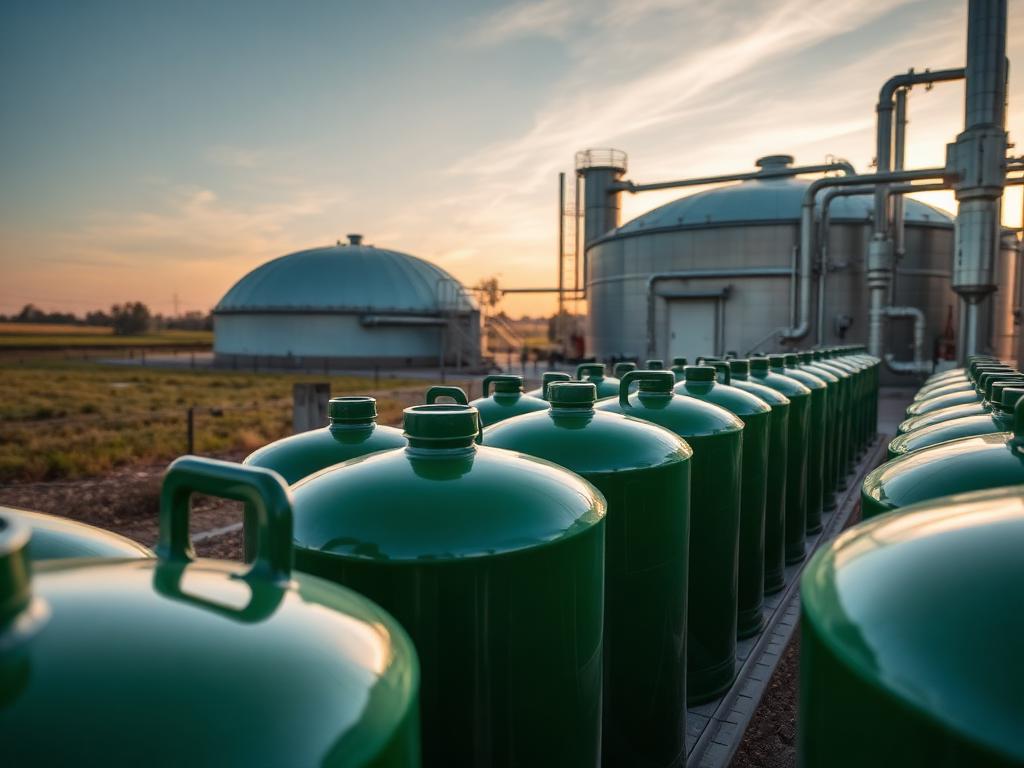
Biorefinery construction site

Standardised Design

One reference plant, one BOQ, one safety code — engineered once, deployed many times.

Procurement Network

Long-term vendor partnerships for digesters, scrubbers, compressors, and CO₂ liquefaction skids.

Construction Management

Dedicated project teams with HSE-first culture and 18-month build-to-commission targets.

Commissioning & Handover

Performance-tested handover to operations with full digital twin documentation.

O&M Playbook

Built-in operations and maintenance protocols ensure consistent uptime and yield across modules.

Capex by Location & Region

Outlay is scoped per cluster — based on geography, feedstock catchment, utilities, and offtake — not a one-size number.

18 mo
Build to commission
3
Cluster services
10 TPD
Standard capacity
ZLD
Engineered standard
Agropolis cluster services

Three integrated services. One landscape-integrated cluster.

Every Agropolis cluster delivers three engineered services in parallel — farming, CBG, and bio-fertilizers — with livestock breeding and allied verticals being phased in as each cluster matures.

Service 01

Farming Cluster

Farming-to-feed — contract cultivation of energy and fodder crops engineered for silage and CBG digestion.

  • • Napier, maize stover, alfalfa, sweet sorghum
  • • Silage value chain & feed security
  • • Feedstock pipeline for the CBG plant
Service 02

CBG Cluster

High-quality, clean Compressed Bio-Gas — engineered to pipeline-grade specification with consistent calorific value.

  • • 10 TPD modular CBG units
  • • Pipeline-grade purity & offtake-ready
  • • Liquid CO₂ & bio-slurry as co-products
Service 03

Bio-fertilizers — value addition

Digestate converted into a full bio-input portfolio across three categories.

  • Nutrition — NPK-rich organic inputs
  • Protection — biocontrol & soil health
  • Speciality — crop-specific formulations

All three services are delivered by Agropolis under one cluster roof — with livestock breeding and allied verticals being added gradually as each cluster matures.

Let us build a new world.

Site selection

CBG Integrated Project — Site Selection Criteria.

Land, feedstock catchment, livestock density, market logistics, and rollout geography — the engineering filters we apply before committing capex to any new cluster.
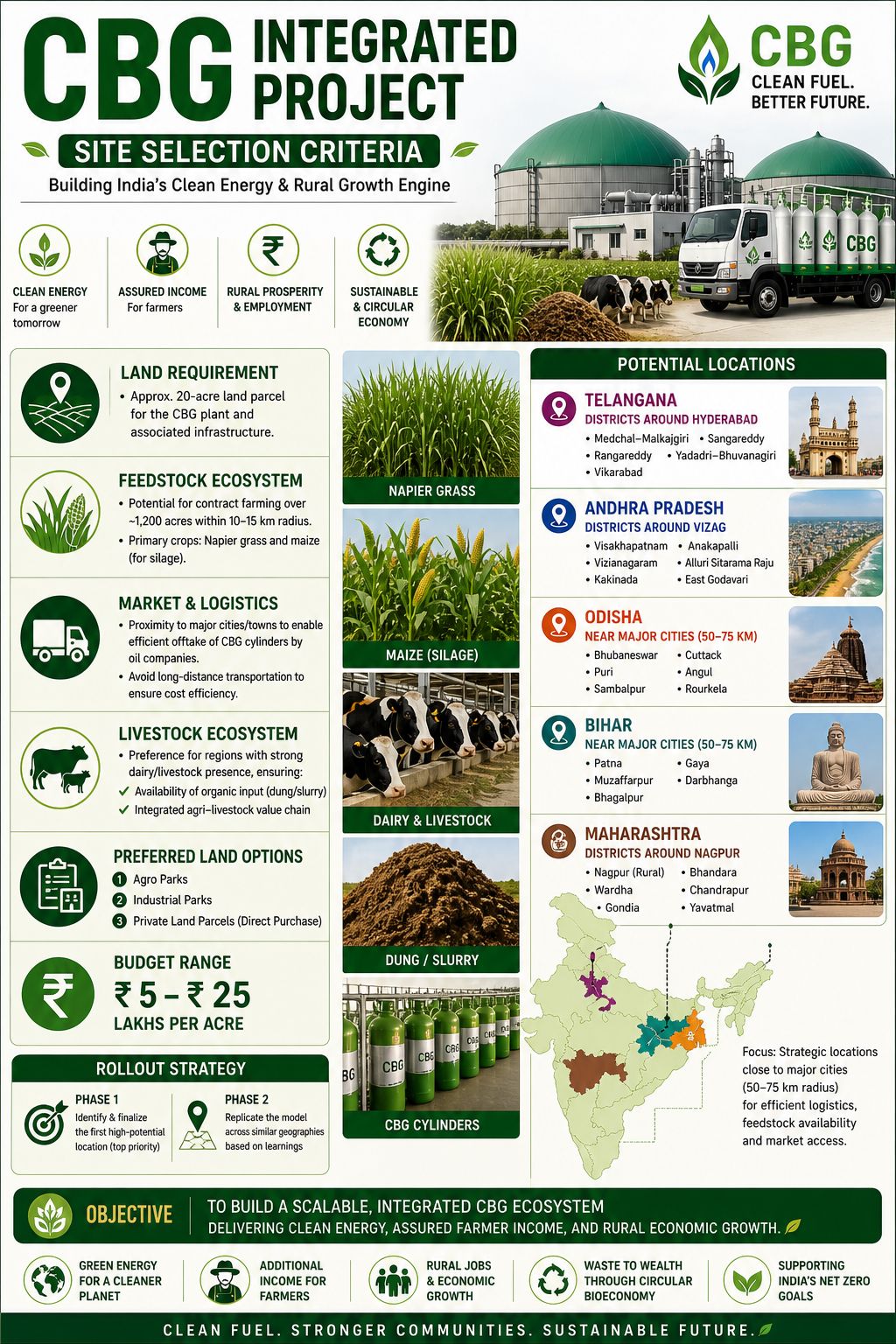
CBG Integrated Project Site Selection Criteria — land, feedstock, market & logistics, livestock ecosystem, preferred land options, budget range, and potential locations across Telangana, Andhra Pradesh, Odisha, Bihar, and Maharashtra
Site Selection Criteria — Building India's Clean Energy & Rural Growth Engine. ~20-acre land parcel, 1,200-acre feedstock catchment within 10–15 km, strong dairy/livestock presence, and proximity to major cities for offtake. Strategic locations across Telangana, Andhra Pradesh, Odisha, Bihar, and Maharashtra — within 50–75 km of major cities for efficient logistics.
Source: Dhakshhin Agropolis Ltd — CBG Integrated Project Site Selection Brief
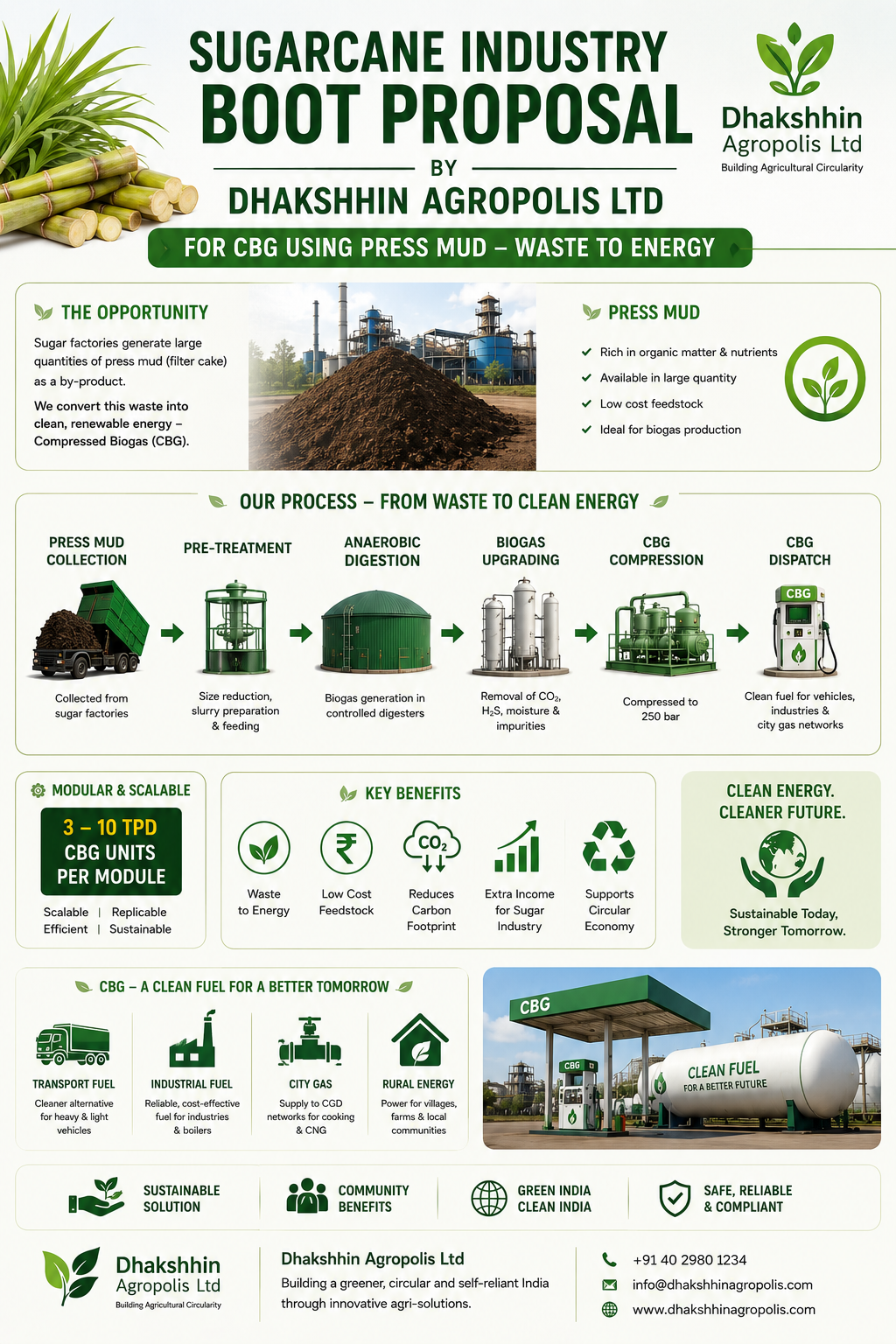
Sugarcane Industry BOOT Proposal — CBG using press mud, waste to energy
Sugarcane Industry BOOT Proposal — CBG from Press Mud. A Build-Own-Operate-Transfer offer to sugar factories: Agropolis converts press mud (filter cake) into pipeline-grade Compressed Bio-Gas through a 6-step process — collection, pre-treatment, anaerobic digestion, biogas upgrading, compression to 250 bar, and dispatch. Modular 3–10 TPD CBG units per module, scalable and replicable. Outputs serve transport fuel, industrial fuel, City Gas Distribution networks, and rural energy — turning a low-cost waste stream into extra income for the sugar industry while reducing carbon footprint.Source: Dhakshhin Agropolis Ltd — Sugarcane Industry BOOT Proposal
Engineering resilience

CBG Unit Design — Core Stress Test.

Designed for variability, engineered for reliability — how our units absorb feedstock shocks and still deliver pure, vehicle-grade CBG aligned to IS 16087:2025.
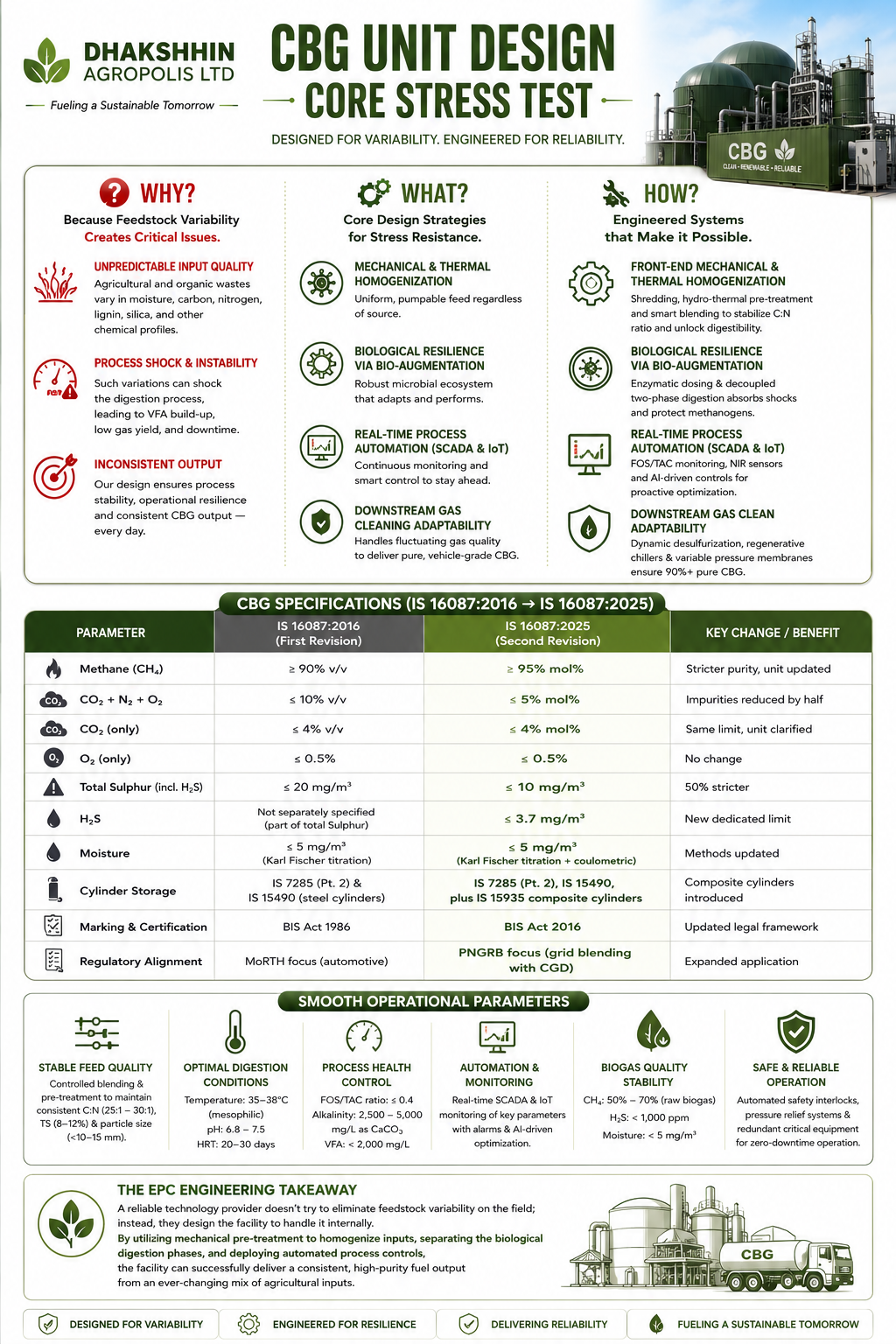
CBG Unit Design Core Stress Test — mechanical & thermal homogenization, biological resilience via bio-augmentation, real-time SCADA & IoT automation, downstream gas cleaning, IS 16087:2016 vs IS 16087:2025 specifications, and smooth operational parameters
CBG Unit Design — Core Stress Test. Designed for variability. Engineered for reliability. Feedstock variability creates critical issues — unpredictable input quality, process shock, and inconsistent output. Our design answers with four engineered systems: front-end mechanical & thermal homogenization, biological resilience via bio-augmentation, real-time SCADA & IoT automation, and downstream gas-cleaning adaptability. The result: ≥ 95 mol% CH₄, ≤ 10 mg/m³ total sulphur, and full alignment with IS 16087:2025 (PNGRB grid blending with CGD).
Source: Dhakshhin Agropolis Ltd — CBG Unit Design Core Stress Test
Integrated model expertise

The integrated model expertise by Dhakshhin — feedstock economics, logistics & risk hedging.

A full discussion note for FPCs, FPOs and project sponsors — covering Hybrid Napier cultivation economics, end-to-end logistics, parity pricing, SWOT against traditional crops, and the landscaping designs for hedging that we engineer into every cluster. Risk analysis is the key — and it sits at the heart of our integrated EPC design.

Unit economics

Available on request

Detailed cultivation economics, logistics build-up, parity pricing, SWOT against traditional crops, and the landscaping designs for hedging are shared directly with FPCs, FPOs, off-takers and project sponsors under NDA. Contact the company →

Silage integration — upstream design

Landscape models win. Farmer wins. Then we win.

Why Agropolis designs every project as a landscape — not a stand-alone unit. A standalone silage SBU collapses under harvesting and mechanisation costs. A standalone CBG plant fights feedstock variability and biological souring. Engineered together, with silage as the upstream pre-treatment step, both businesses become structurally stronger — and the farmer captures a guaranteed, recurring contract.

Unit economics

Available on request

Farmer-side contract economics, the silage cross-subsidy mechanism, integrated CAPEX/OPEX deltas, payback and IRR for the landscape model are shared directly with partners and project sponsors under NDA. Contact the company →

Ready to collaborate?

Partner with us